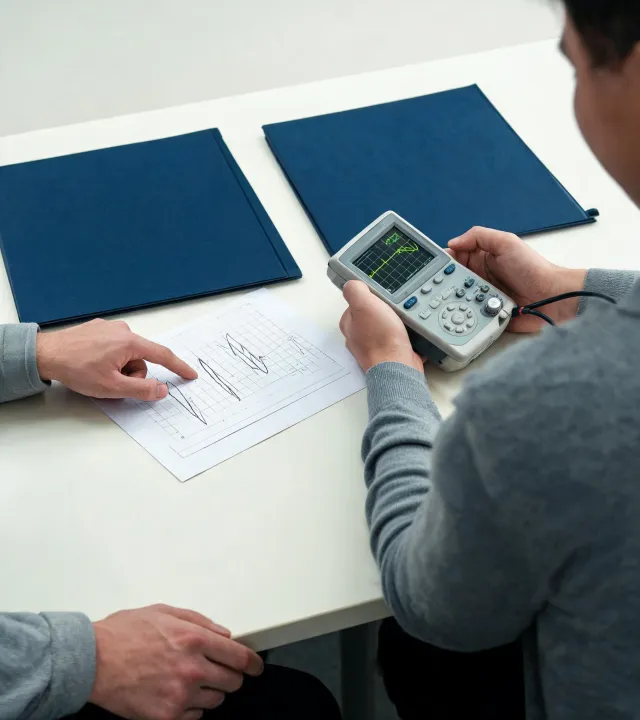
Buyer and sourcing desk reviewing a scope brief

Sourcing desk

LinkScope Sourcing 53 writes the scope brief before any factory is called

LinkScope Sourcing 53 is an independent sourcing partner for portable oscilloscope for sale inquiries. The service name is the desk, not a scope manufacturer and not a stand-in for a probe brand. Factory history, plant photos, and catalog awards from other companies stay with those companies.

The work is a sequence: capture the measurement function, compare replies on one grid, and hand the buyer the open deviations. Incoming inspection criteria can be drafted as questions. They are not presented as audits this desk has already performed.

Share Product Requirements

What the desk will and will not put on a quote grid

Captured from you

Bandwidth, channel count, sample rate, input category, probe attenuation, display or logging, quantity, destination, and requested timing. Optional budget with currency and per-unit or whole-order basis. Supplier preference of high-end, mid-range, budget, or undecided.

Requested from each factory

Exact manufacturer and model, measurement accuracy wording, frequency range, input impedance, calibration traceability, safety category, included probes, freight basis, and exclusions. A 12 month certificate is a request you can make. It is not a certificate this page issues.

Left off the grid

Claims of stock on a shelf, claims of a fixed saving, and claims that a photo equals a test. Return loss, VSWR, insertion loss, optical budget, wavelength, dispersion, gain, MIMO, and channel width stay off a scope grid unless you open another product family on purpose.

Public references such as the IEEE 802 overview and IEC 61010-1 category language are used as question sources. They do not certify a proposed handheld. FCC equipment authorization, when it applies to a radio, is a different file. A basic oscilloscope RFQ should not borrow that status.

Role questions

Who compares the replies?

You do. The desk lines up configuration, currency, and evidence so the lines can be read together. A buyer who wants the maker-named probe because the compensation notes match the manual can say so. A buyer who will accept a compatible probe when attenuation and bandwidth are printed can say that too. The form stores the preference. It does not score the factory.

How are new and refurbished kept apart?

New instruments usually make battery language and probe condition easier to read. Refurbished instruments need the remaining calibration interval and a list of replaced parts. Both can be requested in one round. Collapsing them into a single unit price hides the certificate gap.

Where do managed and unmanaged network arguments go?

They go on a switch brief. A scope purchase does not settle monitoring features, forwarding rate, switching capacity, receiver sensitivity, transmit power, or Power over Ethernet. Mentioning those terms here marks the boundary so a combo quote is not padded with network gear.

Background: a distributor asked the desk to “sound like the factory.” Process: the reply template kept LinkScope Sourcing 53 as the coordinator and required each factory to sign its own model, accuracy statement, and lead time. Result: the buyer could see which sentences came from a supplier and which sentences were still blank. The combo quote page shows the ledger shape. The note lists the attribute names.

Start from the requirement, not from a logo

Paste the known model clues and the unknowns. No file upload is attached to this desk. Production receipt of form messages remains pending a live endpoint check, so a submitted note is a request, not a confirmed ticket number.